If you have a limited marketing budget, the question is rarely “which is best.” It’s “what brings me customers first – and what do I build on from there.” Here’s an honest review for small and mid-sized Norwegian businesses in 2026.
In short
- If you need customers fast – for example for a new website, a seasonal offer or a service area with clear buying intent – you should start with Google Ads.
- Ads give you visibility on Google from day one, but you pay for every click, and the traffic stops when the budget stops.
- SEO takes longer (often 3–6 months before you see movement), but builds visibility you own yourself, and that keeps delivering.
- For most small Norwegian businesses, the answer isn’t “either–or,” but “Ads now, SEO in parallel” – so the ads bring in customers while SEO gradually takes over a bigger share of the job.
What’s actually the difference between Google Ads and SEO?
Both are about being found on Google. The difference lies in how you get there – and what you’re left with afterwards.
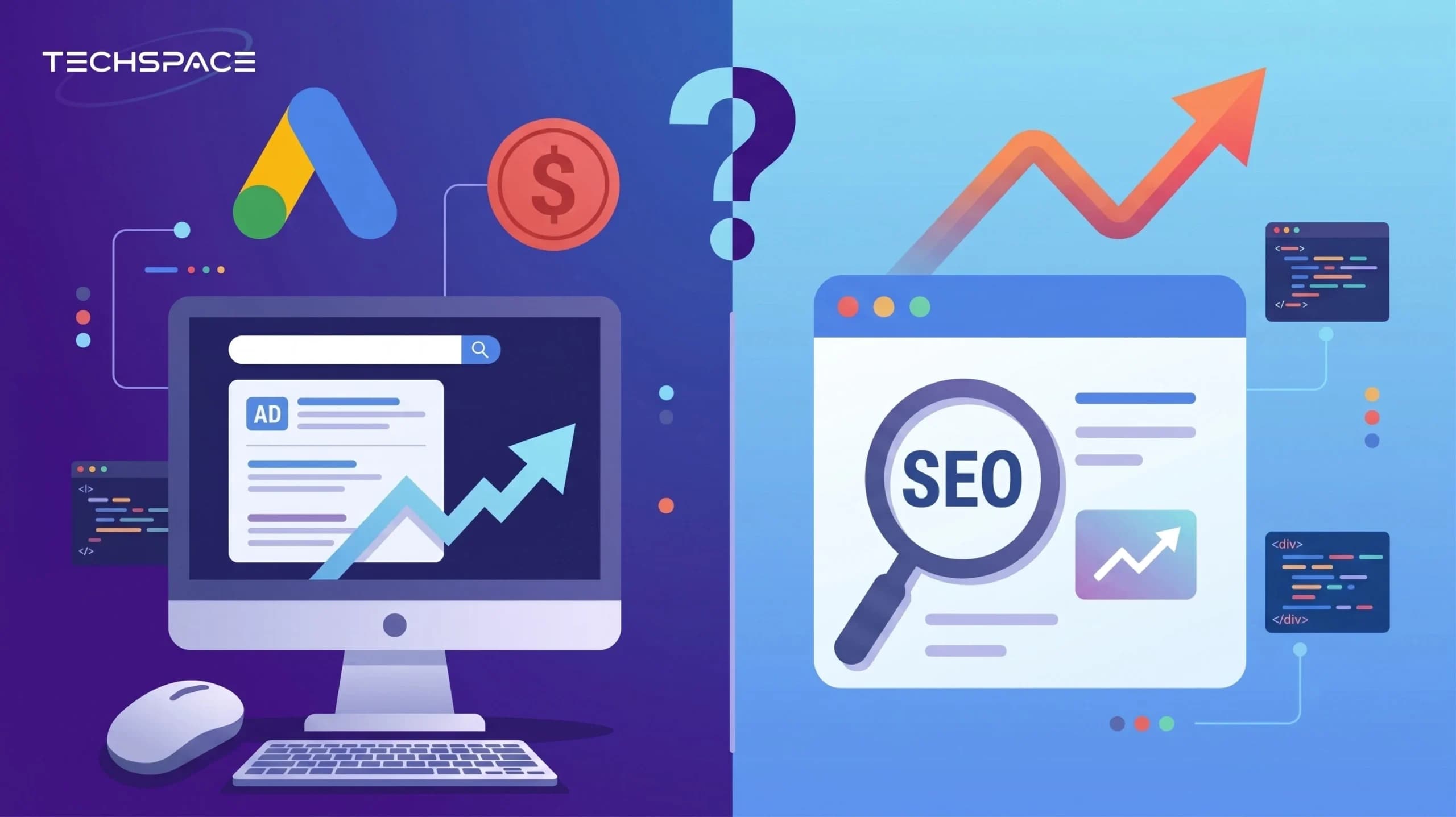
Google Ads are paid ads. You bid on keywords, pay per click (CPC), and the ad shows at the top with the label “Sponsored.” Turn down the budget, and you disappear the same day.
SEO (search engine optimization) is about earning a place in the organic results – through content, technical quality, local visibility and trust. You don’t pay per click, but it takes time to build, and the positions have to be maintained.
| Google Ads (paid) | SEO (organic) | |
| Time to results | Hours–days | 3–6 months+ |
| Cost model | Pay per click, all the time | Investment in work, not per click |
| When you stop paying | Traffic stops immediately | Visibility remains (fades slowly) |
| Control & testing | Full control: budget, keywords, geography, timing | Indirect – you influence, Google decides |
| User trust | Some people deliberately skip ads | Organic results are often seen as more credible |
| Best suited for | Fast demand, offers, new pages | Long-term, compounding visibility |
Worth knowing:
Around 60% of all Google searches end without a click through to a website – people get the answer right in the search results or in an AI summary (SparkToro/Datos, 2024). That means both ad space and a clear, well-structured organic presence become more important – not less. And with AI search, the same basic principles apply: Google itself describes it as “still just SEO.”
5 differences that actually decide the choice
Forget “what’s best in theory.” These are the five things that decide what your business should prioritize:
- How fast do you need customers? If you need to fill a calendar this month, Ads wins. If you’re building for the next two years, SEO wins.
- How big is your margin per customer? High value per customer can handle a higher cost per click in Ads. Low margins make organic traffic more profitable over time.
- How competitive are your keywords? Expensive clicks in a tough market can drain the budget fast – then a long-term SEO position is often cheaper per customer.
- Do you have content and a website that converts? Neither Ads nor SEO will save a site that doesn’t get visitors to get in touch. Traffic without conversion is wasted – whatever the channel.
- How much time and budget do you have for follow-up? Ads need active management to avoid waste. SEO needs patience and steady work. Both need someone keeping an eye on them.
When should you choose Google Ads first?
Ads first
- You’ve just launched or relaunched your website and need customers now
- You sell something with clear buying intent (tradesperson, dentist, lawyer, local service)
- You have a time-limited offer or a season (Christmas, summer, campaign)
- You want to test which keywords and messages actually bring in inquiries – fast
- You’re new to the market and don’t have any organic visibility to rely on yet
SEO first
- You have time and can wait 3–6 months for results
- Click prices in your industry are high, and Ads get expensive per customer
- You’re building a brand and want to own your visibility long term
- Your customers google thoroughly and read up before they buy
- You have (or want to have) content that answers what customers actually wonder about
Notice that the lists don’t rule each other out. Most businesses recognize themselves in points from both – and that’s exactly why the order matters more than the choice.
The truth: most should combine – in the right order
Pitting Ads against SEO is a bit like asking whether you should breathe in or out. They solve different parts of the same problem. The practical approach we recommend to small Norwegian businesses often looks like this:
- Month 0–1: Start Google Ads on the most purchase-ready keywords. You get customers in right away, and – just as important – you learn which searches and messages actually convert.
- Month 1–2: Use what you learn from Ads to prioritize SEO. The keywords that bring in inquiries in Ads are exactly the pages you should build organic visibility around.
- Month 3–6: Let SEO gradually take over. As organic positions are built, you can lower the Ads budget on keywords you now rank well for – and move the money to new areas.
- Ongoing: Keep Ads where it pays off. On the most competitive, purchase-ready searches it’s often smart to have both an ad and an organic position – that way you take up more of the screen.
Not sure what pays off for your business? We look at your website, your market and your numbers and give you an honest recommendation – no obligation. Ask for a no-obligation recommendation.
What does it cost – roughly?
The short answer: it depends on your market and how much visibility you want. Instead of promising numbers we can’t guarantee, we stick to the honest picture:
- Google Ads: You set the budget yourself and pay per click. The cost per click varies a lot between industries. What matters most isn’t the budget itself, but that the ads, the keywords and the landing page fit together – otherwise you pay for clicks that never become customers. We go into this in more detail in our guide to Google Ads for small businesses.
- SEO: Here you pay for work – content, technical work, local visibility – not per click. The cost depends on how competitive your industry is, and where you’re starting from. The effect comes later, but lasts longer. If you want to know what an SEO job actually involves, you can read about SEO and AI visibility.
If you’re also weighing what the website itself costs, we have a separate price guide: What does a website cost in Norway in 2026.
Common mistakes we see
- Turning on Ads for a page that doesn’t convert. Then you’re paying for visits that disappear. Fix the landing page first.
- Expecting SEO results in four weeks. SEO is an investment, not a switch. If you give up too early, you throw away the work right before it starts to pay off.
- Choosing a channel based on what’s cheapest today – instead of what brings in the most customers over time.
- Measuring the wrong things. Clicks and traffic aren’t the goal. Inquiries and customers are. Without tracking forms, phone clicks and conversions, you don’t know what’s actually working.
- Running Ads and SEO completely separately. The two should share data and lessons – otherwise you do the same job twice.
How to decide – a simple model
Ask yourself these questions, in order:
- Do I need customers in the next 30 days? Yes → start with Ads. No → you can build SEO calmly.
- Does my website convert visitors into inquiries today? No → fix the site before you spend a single krone on traffic.
- Do I have the budget to follow up steadily? Yes → run Ads and SEO in parallel. Limited → pick one channel and do it properly, rather than two halfway.
- Do I want to own my visibility in the long run? Yes (almost always) → SEO has to be part of the plan, whatever you start with.
From practice:
What we see again and again: the channel is rarely what decides whether the marketing pays off – it’s whether the website converts. When we helped Norditec fix a technical bottleneck that made the site slow, it became clear how much traffic was otherwise lost before it could turn into an inquiry. Whether you go for Ads or SEO first: make sure the page you send people to is actually built to turn visitors into customers. Otherwise you pay – in money or in time – for visits that drain away.
Frequently asked questions
Is Google Ads or SEO best for a small business?
Neither is "best" on its own. Google Ads brings customers fast, but costs money per click. SEO takes longer, but gives you visibility you own. For most small Norwegian businesses, it works best to start with Ads for a quick effect, and build SEO in parallel so it gradually takes over.
How long does it take before SEO delivers results?
Usually 3–6 months before you see clear movement, and longer for competitive keywords. Local searches and low-competition keywords can move faster. SEO is an investment that builds up over time – not a quick fix.
Can I drop Google Ads once SEO starts working?
You can often lower the Ads budget on keywords you've started ranking well for organically, and move the money to new areas. But on the most purchase-ready searches it's usually smart to have both an ad and an organic position, so you take up more of the search results.
How much budget do I need for Google Ads?
There's no fixed amount – you control the budget yourself, and the right level depends on your industry, cost per click and how many customers you can follow up. What matters most is that the ads, keywords and landing page fit together, so you don't pay for clicks that don't become customers.
Does SEO still work when people use AI search?
Yes. AI answers and AI summaries still draw on content that is clear, credible and well structured – the same principles good SEO is built on. Google itself describes it as "still just SEO." A strong organic presence also makes it more likely that your business gets mentioned when someone asks an AI.
Should I do this myself or use an agency?
You can start smaller campaigns and basic SEO yourself. But both Ads and SEO easily waste time and money without experience – especially on tracking, keyword choice and conversion. An agency is worth it when the cost of getting it wrong is higher than the fee. If you want an honest assessment of your situation, get in touch for a free review.
We review your website for free and tell you what we'd change — in a three-minute video.
Writes about websites, security and visibility for Techspace. Questions about this article? Email us at post@techspace.no.