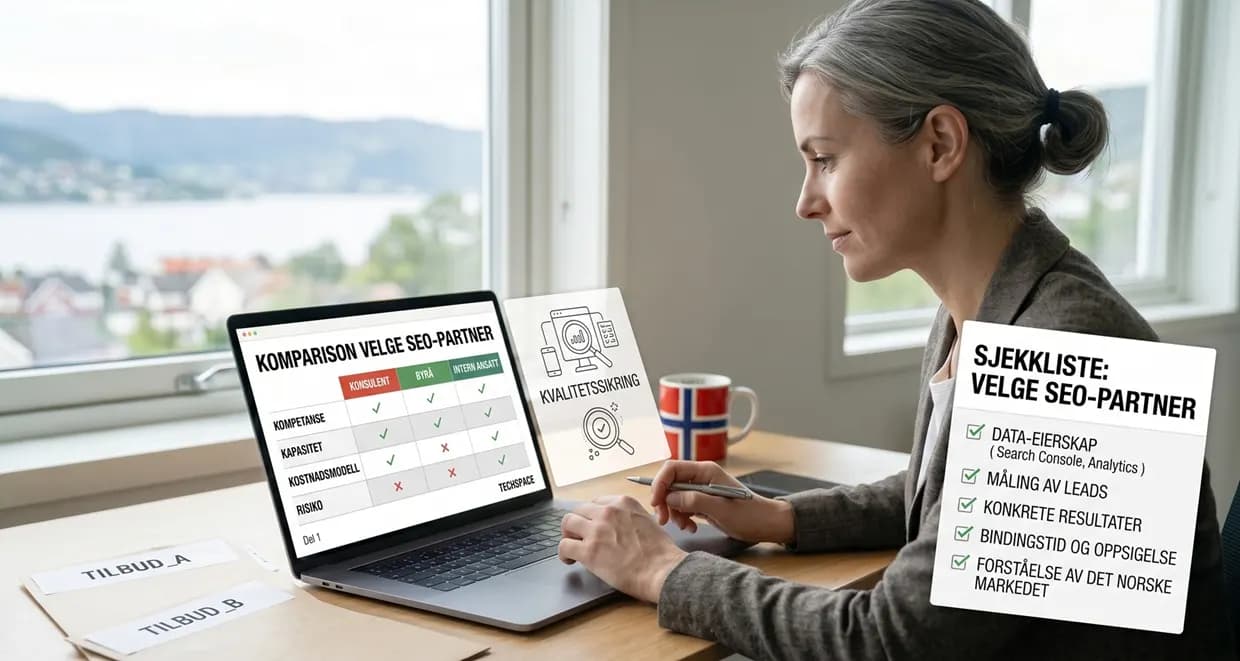
An SEO consultant is usually one person, an SEO agency is a team, and an in-house hire is a fixed cost you own yourself. For most small and mid-sized Norwegian businesses, an agency or a consultant is the right choice – an in-house hire only pays off when SEO is a core activity all year. Prices in Norway are typically NOK 1,000–2,000 an hour, and ongoing agreements from around NOK 5,000 to 40,000 a month depending on scope and competition. What matters most isn't which model you choose, but whether the provider can answer clearly what they'll do, why, how it's measured – and what you're left with if you end the partnership.
“SEO consultant” is not a protected title
It’s worth starting with the uncomfortable part: in Norway there is no authorization, certification or protected title for SEO. No authority approves an SEO consultant the way an auditor or electrician is approved. Anyone can register a sole proprietorship today and call themselves an SEO specialist tomorrow.
That doesn’t make the industry dodgy – there are very skilled people in it. But it puts the entire responsibility for quality assurance on you as the buyer. And that’s exactly why so many small Norwegian businesses have a story about an SEO partnership that cost money without giving anything back.
This guide is written to give you that quality assurance. Not as a sales pitch – we do SEO in Oslo ourselves, and you should ask us exactly the same questions.
Consultant, agency or in-house hire – what’s the difference?
The three models solve the same problem in three different ways. Here’s what actually sets them apart:
| SEO consultant | SEO agency | In-house hire | |
|---|---|---|---|
| Who does the work | One person, often freelance | Team with different specialists | Your own employee |
| Breadth of expertise | Strong where the person is strong | Technical, content, links and analytics under one roof | Depends entirely on who you hire |
| Capacity | Limited – one calendar | Can scale up and down | Full capacity, but only for you |
| Cost model | Hourly rate or smaller monthly agreement | Monthly agreement or project | Salary, employer’s tax, tools, training |
| Risk | Vulnerable to illness or dropout | Can become impersonal if you’re a small client | A bad hire is expensive and takes time to fix |
| Best fit when | You need specialist expertise in a defined area | You want someone else to handle the whole thing | SEO is a core activity all year round |
Rule of thumb
If your business has fewer than ten employees and no marketing department of its own, an in-house SEO hire is rarely the right first step. You end up paying for full capacity in a role you can’t fill – and you lack anyone internally who can judge whether the work is actually up to standard. An agency or consultant gives you the expertise without the fixed cost.
What does SEO cost in Norway in 2026?
The prices are public if you look. Norwegian providers often list hourly rates of around NOK 1,000–2,000, and ongoing monthly agreements in the range of NOK 5,000–40,000. Our own experience is that most small and mid-sized Norwegian businesses end up somewhere between NOK 8,000 and 35,000 a month, depending on how competitive the industry is and how much needs to be done on the website to begin with.
But price alone says little. Two quotes at NOK 15,000 a month can contain completely different things. What actually determines the value is:
- How many hours are behind the amount – and who does them.
- What’s included: technical work, content production, local visibility, link building, reporting.
- Where you’re starting from. A website with technical problems needs cleaning up before anything else works.
- How tough the competition is. “Plumber Oslo” and “accountant for sole proprietorships” don’t require the same effort.
Be extra alert here
Very low fixed prices – for example “SEO from NOK 990/month” – rarely cover more than an automated report and a few small tweaks. It’s not necessarily a scam, but you should know exactly how many hours of work you get, and what they’re spent on. Ask for it in writing.
10 questions you should ask before you sign
This is the core of the guide. Ask the questions in a meeting, and listen as much to how they answer as to what they answer. A skilled provider is never irritated by good questions.
1. “What’s the first thing you’d do on our website – and why exactly that?”
GOOD ANSWER They’ve looked at your site before the meeting, and point to something concrete: a technical error, missing landing pages, weak local visibility.
WARNING A generic answer about “keyword research and optimization” without mentioning your site specifically.
2. “Can you show examples of previous work and results?”
GOOD ANSWER Concrete case studies, ideally from comparable businesses, with numbers they can explain. Google itself recommends asking for exactly this.
WARNING Just logos on a wall, or results they can’t say anything about “due to confidentiality” in every single case.
3. “What results do you expect, and within what time frame?”
GOOD ANSWER Realistic and with caveats: movement after 3–6 months, full effect later, depending on the competition.
WARNING A guaranteed #1 spot, or “results in 30 days.” Google is clear that nobody can guarantee a #1 ranking – and that you should be skeptical of anyone claiming a “special relationship” with Google.
4. “Will we be told about every change you make on our website?”
GOOD ANSWER Yes, everything is logged, and you get to see it. This is also Google’s own recommendation.
WARNING Vagueness about methods, or “it’s our own method, we can’t go into it.”
5. “Who owns Google Search Console, Analytics and the domain – and the content you create?”
GOOD ANSWER You own everything. The agency gets access, not ownership. Google also recommends that you only give read access to Search Console during the initial analysis phase.
WARNING Accounts created on the agency’s email, or content that “belongs to the deliverable” and disappears when you cancel. This is one of the most common traps.
6. “How do you build links?”
GOOD ANSWER Content, press coverage, industry directories that are actually relevant, partnerships. They can explain why each link makes sense.
WARNING Packages of “500 links,” private blog networks or bought links. Google describes link schemes as a red flag – and it’s you, not the agency, who’s left with the risk to your site.
7. “What do you measure – and do you report on inquiries, not just traffic?”
GOOD ANSWER They talk about form submissions, phone clicks and qualified inquiries, not just rankings and visitor numbers.
WARNING Reports full of “impressions” and rankings for keywords no customer actually uses.
8. “Who actually works on our account day to day?”
GOOD ANSWER A name, a role and a dedicated contact person you can reach.
WARNING The salesperson you talk to is the only person you meet – and the work is outsourced to someone you never find out about.
9. “What’s the lock-in period, and what happens if we cancel?”
GOOD ANSWER Short or no lock-in period, a clear notice period, and everything you’ve paid for stays with you.
WARNING 12 or 24 months of lock-in with no way out – especially combined with them owning your accounts.
10. “Do you have experience with our industry and the Norwegian market?”
GOOD ANSWER They know how Norwegian customers actually search, and that directly translated English keywords rarely hit the mark.
WARNING Content and strategy obviously made for an English-speaking market and translated afterwards.
Already received a quote you’re unsure about? Send it to us, and we’ll tell you honestly what we think of it – even if the conclusion is that you should say yes to someone else.
Red flags – and what Norwegian law actually says
Google publishes its own list of warning signs for when you’re hiring SEO help. The most relevant for small Norwegian businesses:
Red flags
- Unsolicited email or phone call: “we’ve found errors on your website”
- A guaranteed #1 spot on Google
- Claims of a “special relationship” with Google
- Secrecy about what they actually do
- Link packages and mass submission to search engines
- Tools claimed to be “approved by Google”
- Pressure to sign at the meeting
Good signs
- They ask questions about your business before suggesting anything
- They say clearly what they can’t promise
- They want to start with an analysis, not a package
- They explain how the results will be measured
- They’re comfortable with a short lock-in period
- You own all accounts and all content
It’s also worth knowing that you have protection under Norwegian law. Section 26 of the Norwegian Marketing Control Act (markedsføringsloven) prohibits misleading commercial practices toward businesses – in other words, toward your business, not just toward consumers. A salesperson who promises guaranteed rankings he can’t possibly deliver is moving into that territory. It doesn’t make the money easier to get back, but it’s a good argument to have in your back pocket, and a reminder to get every promise in writing.
What a serious SEO engagement actually includes
Whether you choose a consultant or an agency, the work should cover these four areas. If one of them is missing entirely, you should ask why.
- Technical foundation. Speed, mobile display, indexing, structure and security. If this is wrong, it doesn’t matter much how good the content is.
- Content that answers real searches. Pages built around what Norwegian customers actually type in – not translated English keywords.
- Local and external visibility. Google Business Profile, consistent business information, reviews, and links that are earned rather than bought.
- Measurement and follow-up. Tracking of forms and phone clicks, regular reports, and a plan that’s adjusted based on what the numbers show.
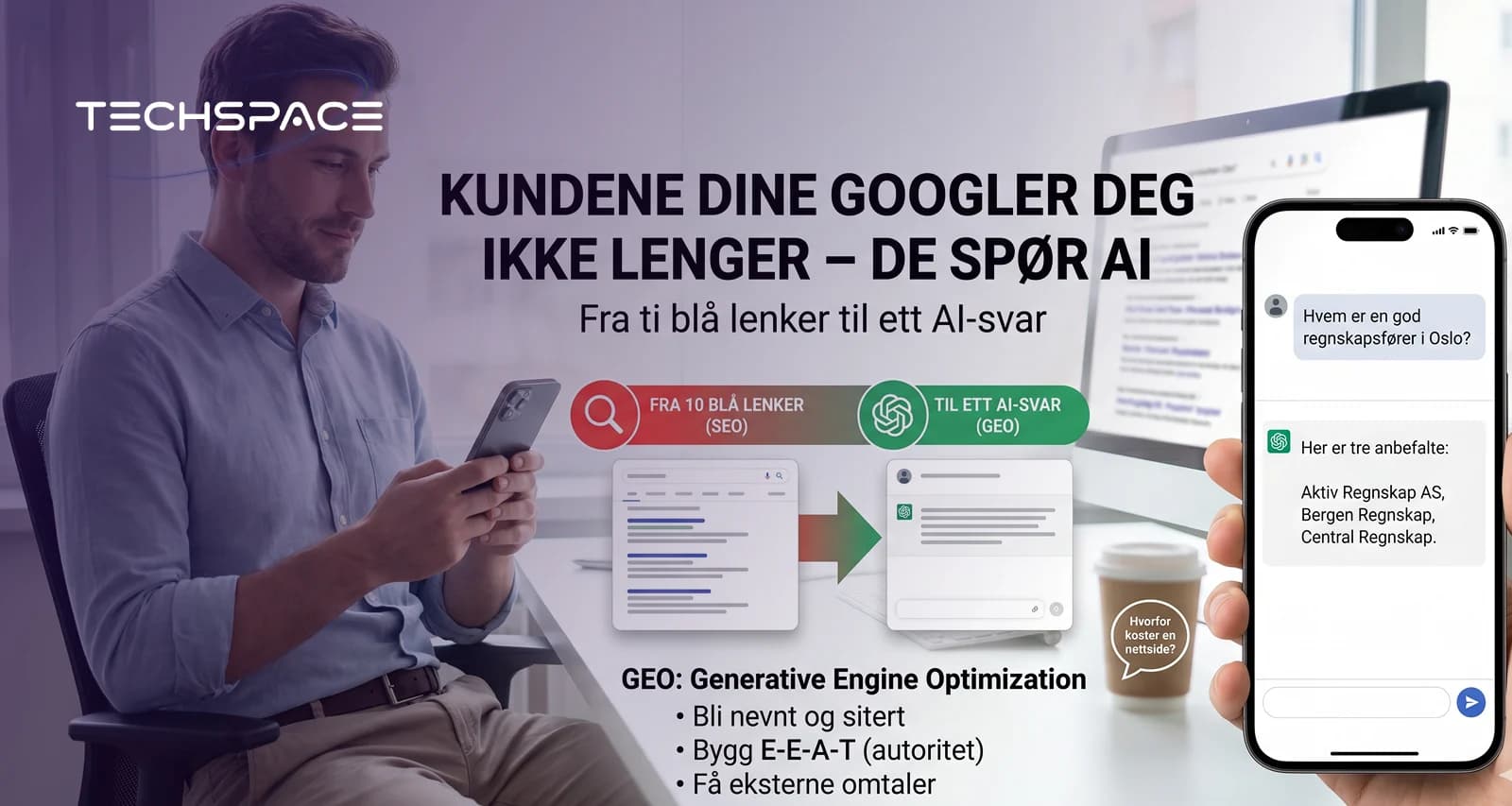
A fifth point is becoming just as important: whether your content is written so that AI answers can actually use it. If a provider promises you “AI visibility” as something entirely separate, ask them to explain what they concretely do differently – the basic principles are largely the same.
The contract: six points you should check
- Lock-in period and cancellation. How long are you tied in, and how long is the notice period?
- Ownership. Are the domain, Search Console, Analytics and Google Business Profile registered to you?
- Content and links when you end it. Do the texts and pages stay, or are they removed?
- Scope. How many hours, which tasks, and what does work beyond the agreement cost?
- Reporting. How often, what’s measured, and who goes through it with you?
- Subcontractors. Is any of the work outsourced, and if so, what?
From practice
What we see most often when a new client comes from a previous SEO partnership isn’t that directly harmful things have been done. It’s that nobody can answer what was actually done, why – or who owns the accounts. Then the first few weeks go to cleanup instead of progress. Clarifying ownership and documentation before you sign is the cheapest move in this entire guide.
How to tell if it’s actually working
Three months into a partnership, you should be able to see something. Not necessarily more customers yet, but movement. Look for this:
- Google Search Console: rising impressions and better average position for keywords with buying intent – not just for your company name.
- Analytics: more engaged sessions from organic search, not just more clicks.
- Inquiries: forms and phone calls that can be traced back to organic search.
- The work itself: new or improved pages you can see with your own eyes.
If all you get is a report with green arrows and no explanation of what was done this month, it’s worth asking. If you’re still unsure whether to invest in organic visibility or ads first, we go through that trade-off in “Google Ads or SEO – which should you choose first?“.
Frequently asked questions
What’s the difference between an SEO consultant and an SEO agency?
An SEO consultant is usually one person, often freelance, with specialist expertise in one or more areas. An SEO agency has a team of specialists in technical SEO, content, link building and analytics. A consultant can be more flexible and cheaper for defined tasks, while an agency has broader capacity and copes better if one person drops out. For most small Norwegian businesses, the choice mostly comes down to how much you want to manage yourself.
What does an SEO consultant cost in Norway?
Norwegian providers often list hourly rates of around NOK 1,000–2,000, and ongoing monthly agreements from roughly NOK 5,000 to 40,000. Most small and mid-sized businesses end up between NOK 8,000 and 35,000 a month. The price depends on the competition in the industry, the state of the website and how much work actually goes in – always ask for the number of hours and the tasks to be specified in writing.
Can an SEO agency guarantee a #1 ranking on Google?
No. Google is clear that nobody can guarantee a #1 ranking, and warns against anyone who promises it or claims to have a special relationship with Google. A serious provider gives you realistic expectations and explains what affects the result, not a promise of a specific position.
How long does it take before SEO delivers results?
Usually 3–6 months before you see clear movement, and longer for competitive keywords. Local searches can move faster. After three months you should in any case be able to see concrete progress in Search Console and in the work that’s been done, even if the customers haven’t arrived yet.
Should I hire an in-house SEO consultant instead?
It only pays off when SEO is a core activity all year and you have enough work to fill a position. An in-house employee costs salary, employer’s tax, tools and training, and a bad hire is expensive to fix. If you have fewer than ten employees and no marketing department of your own, an agency or consultant usually gives you more expertise per krone.
Who should own Google Search Console and Analytics?
You, always. The accounts should be registered to the company’s own email address, and the provider should have access as a user – not ownership. Google also recommends that you only give read access to Search Console during the initial analysis phase. Check this before you sign; it’s one of the most common sources of trouble when a partnership ends.
What do I do if my SEO agency doesn’t deliver?
Ask for a written overview of what’s been done in recent months and how it’s measured. Then check for yourself in Search Console whether impressions and positions are moving for keywords with buying intent. If you can’t get clear answers, go through the contract for the notice period and ownership before you cancel – and make sure you secure access to your accounts first.
We review your website for free and tell you what we'd change — in a three-minute video.
Writes about websites, security and visibility for Techspace. Questions about this article? Email us at post@techspace.no.